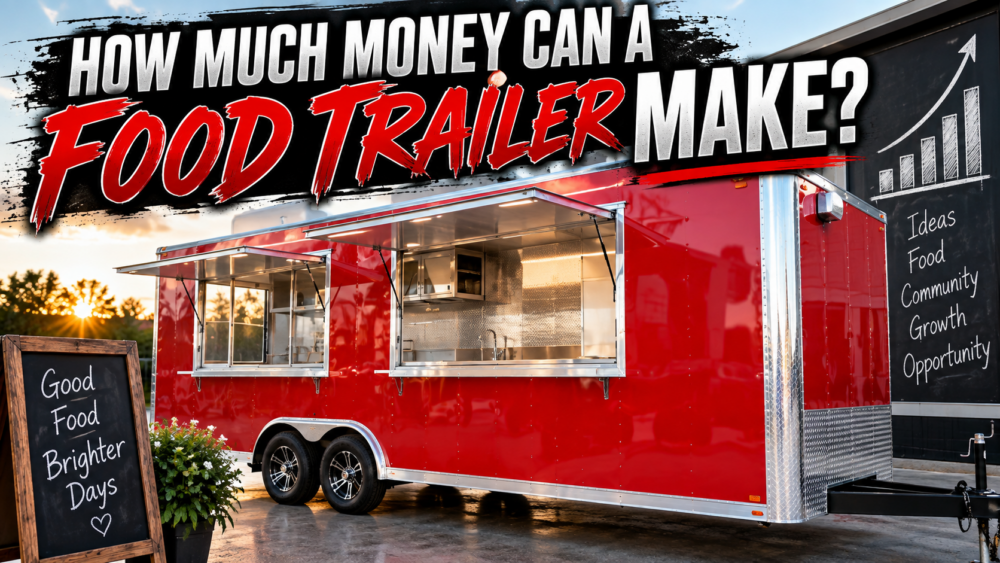
If you’re thinking about starting a food trailer business, one of the first questions you probably have is simple:
How much money can a food trailer actually make?
The answer depends on what you sell, where you operate, how often you work, and how well you control your expenses. But a well-run food trailer can become much more than a weekend side hustle. For some owners, it becomes a full-time business with the potential to generate six figures in annual sales.
The advantage of a food trailer is that you’re not tied to one location. You can go where the customers are — lunch crowds, festivals, fairs, sporting events, concerts, breweries, private parties, weddings and community events.
Let’s break down the numbers and look at what determines how profitable a food trailer can be.
How Much Revenue Can a Food Trailer Generate?
There isn’t one average number that applies to every food trailer.
A trailer operating three days a week in a small town will have very different sales than one traveling to large festivals every weekend.
A simple way to estimate potential revenue is to look at the number of customers served and the average ticket price.
For example, suppose your average customer spends $15.
If you serve:
| Customers Per Day | Average Ticket | Daily Sales |
|---|---|---|
| 50 | $15 | $750 |
| 100 | $15 | $1,500 |
| 150 | $15 | $2,250 |
| 200 | $15 | $3,000 |
At 100 customers per day, four days per week, that’s approximately $6,000 in weekly gross sales.
Over 50 operating weeks, that would equal roughly $300,000 in gross annual revenue.
That’s revenue — not profit — but it shows why location and customer volume can make such a dramatic difference.
Revenue Isn’t the Same as Profit
This is one of the most important things for a new food trailer owner to understand.
If your trailer sells $200,000 worth of food during the year, you haven’t made $200,000.
Your business still has expenses.
Those may include:
- Food and ingredients
- Packaging and disposable supplies
- Employee wages
- Fuel
- Propane
- Generator or electrical costs
- Commissary kitchen expenses
- Insurance
- Permits and licenses
- Event and vendor fees
- Credit-card processing fees
- Marketing
- Maintenance and repairs
- Trailer and tow-vehicle payments
What remains after those expenses is your actual operating profit.
That means controlling costs can be just as important as increasing sales.
What Could a Food Trailer Owner Actually Take Home?
Let’s look at a realistic full-time example.
Imagine a food trailer operates 4 days a week and averages $2,000 to $2,500 per operating day, generating $35,000 in gross sales for the month.
After paying for food inventory, labor, fuel, insurance, event fees, and general overhead, a well-managed trailer keeping a 20% net profit margin would yield $7,000 in net profit for the month ($84,000 annually).
On the other hand, an operator working a part-time schedule ($15,000 in monthly sales) might bring home around $3,000 a month, while a high-volume festival trailer doing $50,000+ a month can take home six figures net.
This is why asking “How much does a food trailer make?” depends entirely on your setup. The goal isn’t just generating sales — it’s controlling your expenses so you maximize what stays in your pocket.
The better question is:
How much can I sell — and how much will it cost me to make those sales?
Your Menu Can Make or Break Your Profit
A successful food trailer doesn’t necessarily need a huge menu.
In fact, a smaller, focused menu can make the operation easier to manage.
Consider items that are:
Fast to prepare. Long ticket times limit how many customers you can serve during your busiest hours.
Easy to repeat consistently. Customers should receive the same quality whether they’re first or 100th in line.
Profitable. Ingredient cost needs to leave enough room to cover your other expenses.
Easy to store. Space inside a food trailer is valuable.
Built around shared ingredients. If several menu items use many of the same ingredients, you can simplify inventory and potentially reduce waste.
BBQ, burgers, tacos, sandwiches, wings, loaded fries, coffee, desserts and specialty foods are common concepts because operators can build focused menus around them.
The best concept, however, is one that works in your particular market.
Location Can Be More Important Than the Food
You can have incredible food and still struggle if nobody knows where to find you.
One of the biggest advantages of owning a food trailer is mobility.
Instead of waiting for customers to come to a permanent restaurant, you can potentially take the business to them.
That might include:
Lunch locations: factories, industrial parks, office complexes and construction areas.
Community events: fairs, festivals, farmers markets and downtown events.
Entertainment venues: breweries, concerts, sporting events and race tracks.
Private events: weddings, corporate gatherings, birthdays and reunions.
Regular weekly locations: businesses or properties where you’ve arranged permission to operate.
A strong operator may use several of these strategies rather than depending on one location.
Events Can Produce Big Sales — But Watch the Fees
A busy festival can expose a food trailer to thousands of potential customers.
That’s exciting, but don’t automatically assume a large crowd means a large profit.
Some events charge substantial vendor fees. Others may require a percentage of sales.
Before committing, estimate:
Expected attendance × realistic percentage of customers × average ticket = potential sales.
Then subtract the event fee, food cost, labor, travel and other expenses.
A $5,000 sales day sounds fantastic.
But a $5,000 sales day with unusually high vendor fees and labor expenses is very different from $5,000 generated at a regular location with much lower operating costs.
Catering Can Add Another Revenue Stream
Your serving window doesn’t have to be the only way your trailer earns money.
Private catering can potentially provide another revenue stream.
Businesses may book food trailers for employee lunches. Couples may hire one for a wedding. Families may want one at a graduation or birthday party.
Some operators establish a minimum booking amount for private events.
For example, rather than hoping enough guests purchase food individually, the customer may guarantee a minimum amount of sales.
That can make revenue more predictable.
Could a Food Trailer Become a Six-Figure Business?
Yes — in terms of gross annual sales, the math makes it possible.
Consider a trailer averaging:
$2,000 per operating day × 3 days per week × 50 weeks = $300,000 in annual gross sales.
Even:
$1,000 per day × 3 days per week × 50 weeks = $150,000 in annual gross sales.
But these are illustrations, not guarantees.
Weather, seasonality, competition, menu pricing, location, food costs, staffing and local demand can all dramatically affect actual results.
And again, gross sales are not what the owner takes home.
How Many Customers Do You Need?
Working backward from your income goal can be extremely helpful.
Suppose your goal is $1,500 in sales for the day and your average ticket is $15.
You need approximately:
100 customers.
Increase the average ticket to $18 and you’d need roughly:
84 customers.
That’s why upselling can matter.
Adding drinks, sides, desserts or combination meals can increase the average transaction without requiring another customer to walk up to the window.
An extra $3 per order across 100 customers is another $300 in daily revenue.
Don’t Forget the Cost of Starting a Food Trailer
Before you start calculating profit, you also need to consider startup expenses.
The trailer itself is only part of the investment.
Depending on your business and local requirements, your startup budget could include cooking equipment, refrigeration, sinks, water tanks, plumbing, electrical systems, ventilation, fire-suppression equipment, generators, propane systems, signage, POS equipment, permits, insurance and initial inventory.
Requirements vary considerably by state and local jurisdiction.
Always check with your local health department, fire authority and other applicable agencies before ordering or building a food trailer.
It’s much easier to design the trailer around your requirements than discover after the build that something needs to be changed.
Why Starting With the Right Food Trailer Matters
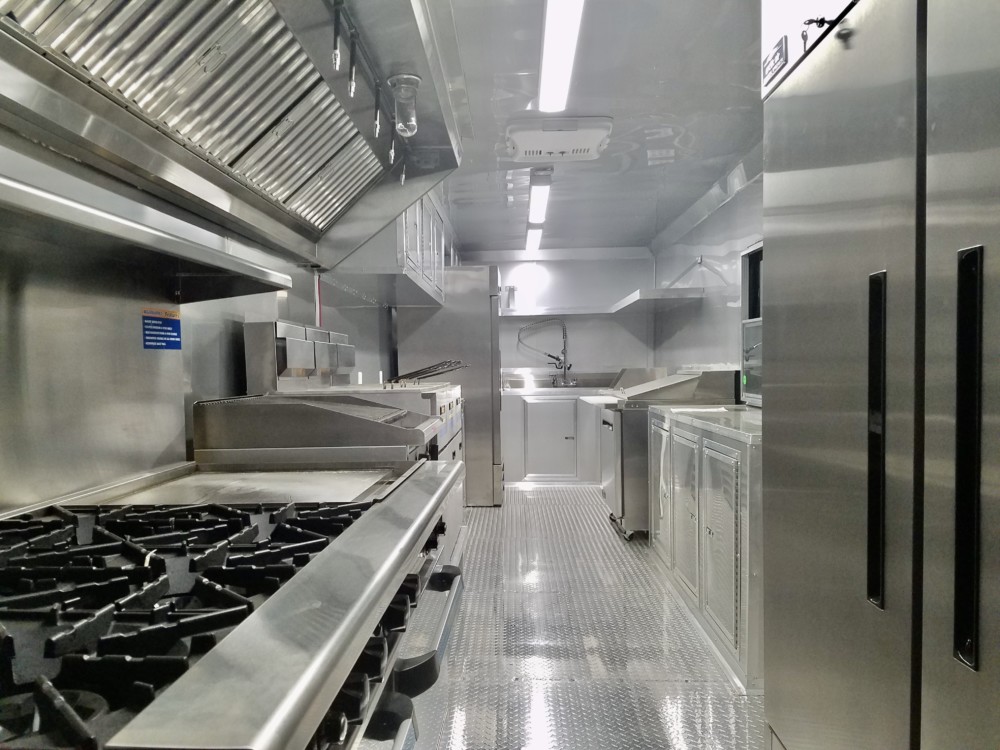
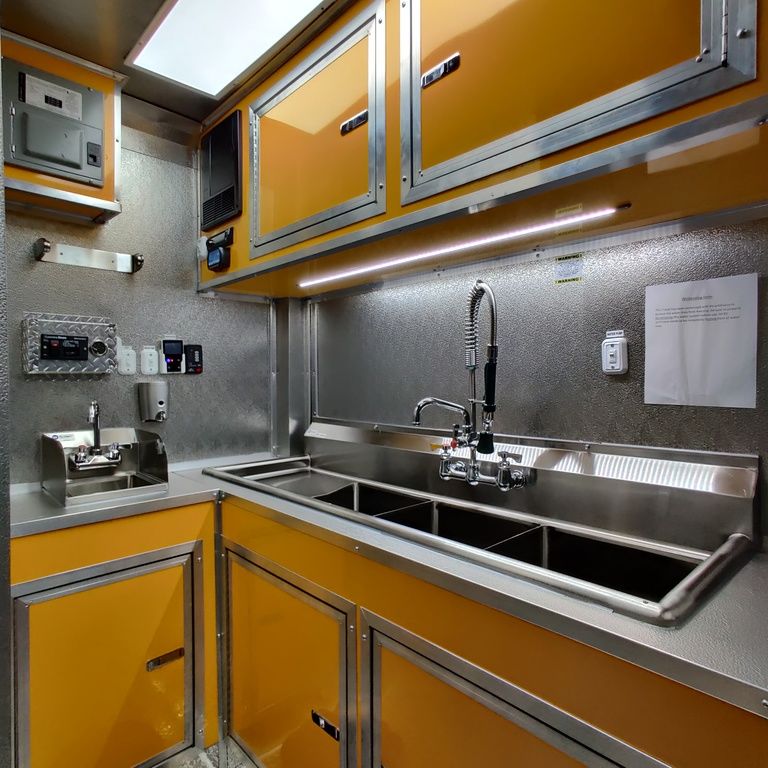
Your trailer is essentially your restaurant’s kitchen, storage room and storefront on wheels.
The layout matters.
Where will employees stand?
Where will food be prepared?
How many people need to work inside?
Where will refrigeration go?
Where should the sinks be located?
What cooking equipment will you need?
Where will customers order and receive their food?
How much fresh and wastewater capacity do you need?
Those decisions affect how efficiently your team can work when there’s a line of customers outside.
A poorly planned layout can slow down every order.
A well-planned layout can help keep the operation moving.
Custom Food Trailers Give You More Control
This is where starting with a trailer designed around your business can make a major difference.
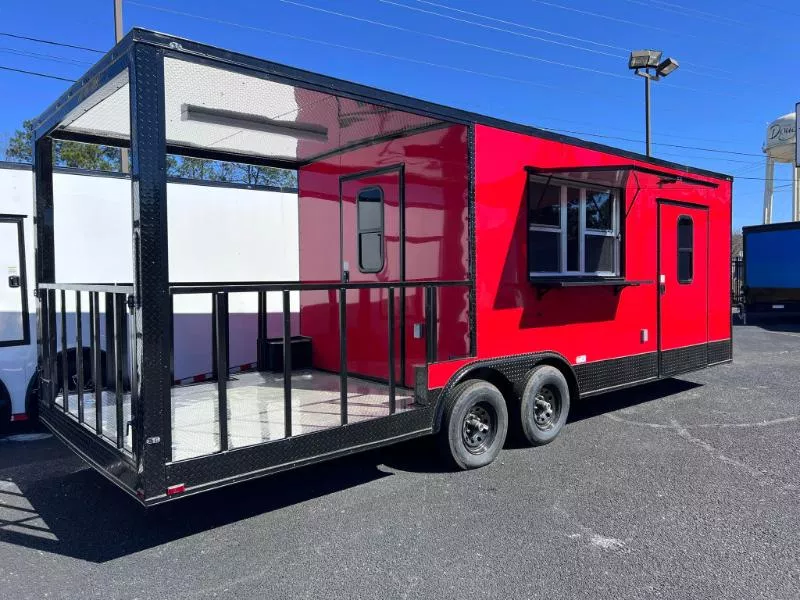
At Renown Cargo Trailers, we can help customers build concession and food trailers around the type of business they want to operate.
Depending on the build and requirements, that may include serving windows, counters, electrical packages, sinks and plumbing provisions, finished interiors, equipment layouts and other custom options.
Instead of trying to force your business into somebody else’s layout, you can start with a trailer designed around your workflow and your menu.
How to Increase Your Food Trailer’s Earning Potential
Making more money doesn’t always mean working more hours.
Sometimes it means making each hour more productive.
Focus on a few fundamentals:
Choose profitable menu items. Know what every item costs you to produce.
Keep service fast. During a rush, every minute matters.
Increase your average ticket. Drinks, sides, combos and desserts can add revenue to existing orders.
Build repeat locations. Regular customers can provide a more predictable sales base.
Use social media. Tell customers where you’ll be before you arrive.
Track your numbers. Know your sales, food cost, labor cost and profit from each location or event.
Don’t chase every event. A smaller event with low fees can sometimes be more profitable than a huge festival with expensive vendor costs.
So, How Much Money Can a Food Trailer Make?
There isn’t a guaranteed number.
A food trailer might produce a few hundred dollars during a slow day or several thousand dollars during a strong event. A successful operation working consistently can potentially generate substantial annual revenue.
But the operators who build sustainable businesses don’t focus only on sales.
They focus on profit.
The goal isn’t simply to have the longest line.
It’s to build a business where the numbers work after the food, labor, fuel, fees and other expenses are paid.
And that starts before the first meal is ever served — with a solid business plan and a food trailer designed to support it.
Ready to Build Your Food Trailer?
Whether you’re turning a family recipe into a business, expanding an existing restaurant, adding mobile catering or starting something completely new, Renown Cargo Trailers can help you build a concession trailer around your vision.
Choose the size, layout, serving windows, interior configuration and available options that make sense for your operation.
If you can dream it, we can build it.
Renown Cargo Trailers
Douglas, Georgia
888-287-3954
Nationwide Delivery Available
Financing available