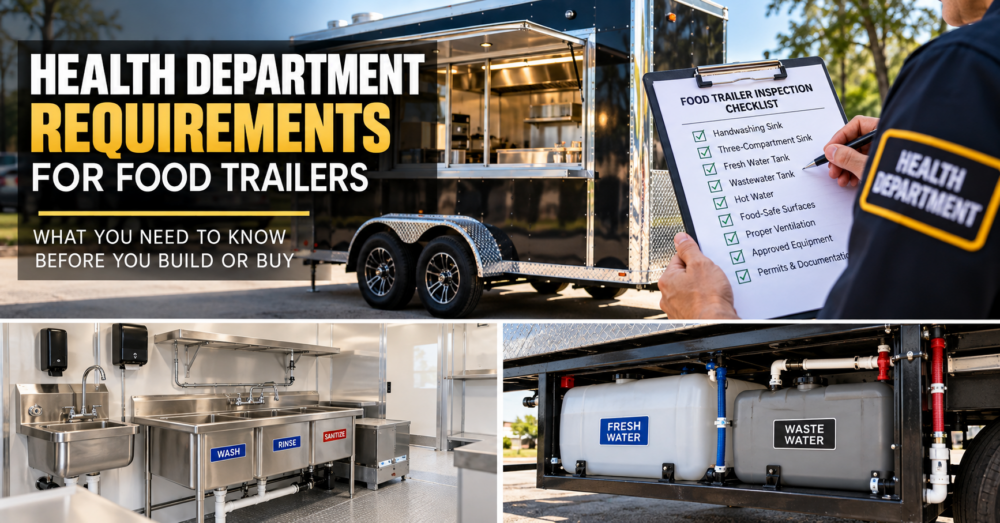
Starting a food trailer can be an exciting way to turn a food concept into a real business without opening a traditional brick-and-mortar restaurant. But before you choose your trailer size, equipment, concession windows, or exterior color, there is one important step that should come first:
Find out what your local health department requires.
Health department requirements for food trailers can affect nearly every part of your build, including sinks, plumbing, water tanks, hot water, refrigeration, food preparation areas, ventilation, equipment, flooring, walls, and even where the trailer can be serviced.
Getting those details right before your food trailer is built can save you from expensive changes later.
At Renown Cargo Trailers, we build custom concession trailers and food trailers for customers across the country. One of the most important things we tell buyers is simple:
Your food trailer should be designed around both your business and the requirements of the jurisdiction where you plan to operate.
Are Food Trailer Health Department Requirements the Same Everywhere?
No.
This is one of the most important things to understand when researching mobile food trailer requirements.
The FDA publishes the Food Code as a model for food-safety regulations, but the FDA itself explains that the code is intended for adoption and use by state, local, tribal, and territorial regulatory agencies. Your actual requirements therefore depend on the rules adopted by the authority that regulates your food business. U.S. Food and Drug Administration
That means a food trailer approved in one jurisdiction may need different equipment or documentation to operate somewhere else.
Before ordering a trailer, contact the health department or regulatory authority where you intend to operate and ask specifically about requirements for a mobile food unit, mobile food establishment, concession trailer, or food trailer.
1. Start With Your Menu
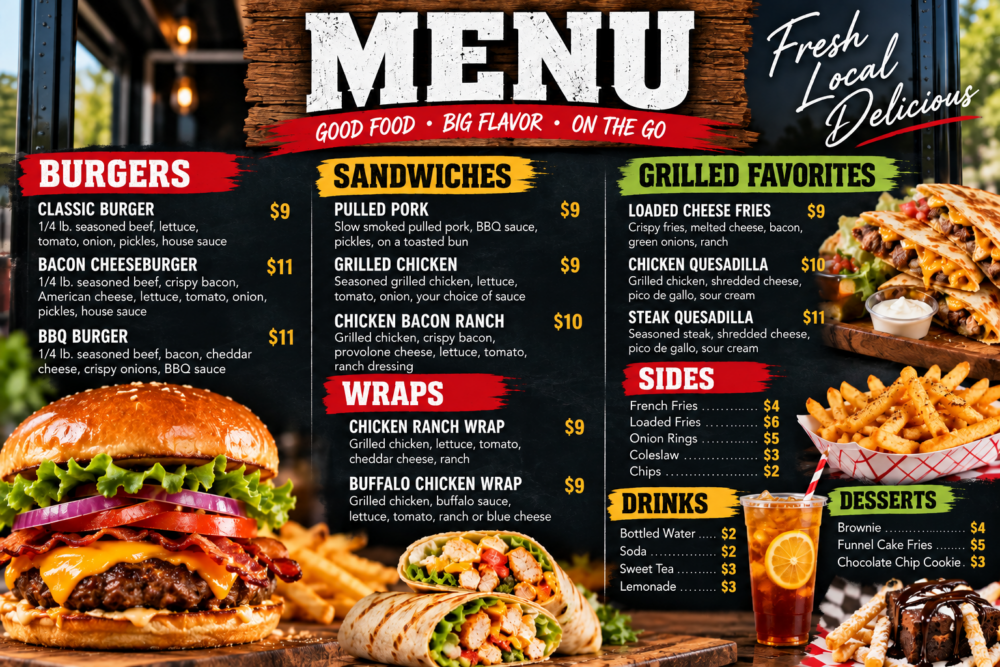
This might surprise first-time food trailer owners, but your menu can influence your trailer design.
There is a big difference between a trailer serving prepackaged products and one preparing raw meat, frying food, cooking full meals, or handling other foods requiring temperature control.
Your menu helps regulators determine what equipment and food-safety controls your operation will need.
Before finalizing your food trailer layout, create a realistic menu and determine:
- What foods will be prepared inside the trailer?
- Will raw meat or poultry be handled?
- Will you fry, grill, bake, boil, or reheat food?
- What foods require refrigeration?
- What foods need hot holding?
- How will ingredients be stored?
- How will food-contact equipment and utensils be washed?
- How much food preparation space will you need?
Changing the menu later can sometimes change the equipment or regulatory requirements for the operation.
2. Food Trailer Handwashing Sink Requirements
A dedicated handwashing sink is one of the most common requirements for a food trailer.
Under the FDA Food Code model, handwashing sinks must be conveniently located for employee use in food preparation, dispensing and warewashing areas. The current requirements adopted in your jurisdiction should always be verified before construction.
Hot and cold or tempered running water may also be required.
For example, the 2022 FDA Food Code requires a handwashing sink to provide water at a temperature of at least 85°F through a mixing valve or combination faucet. U.S. Food and Drug Administration
Your local code may differ depending on which Food Code edition and additional rules your jurisdiction has adopted.
Do not assume that installing any small sink automatically makes a food trailer compliant.
Ask your health department about the required sink size, location, water temperature and plumbing arrangement.
3. Three-Compartment Sink Requirements for Food Trailers
Many food trailers that wash reusable utensils and equipment need a three-compartment sink for washing, rinsing and sanitizing.
This is separate from the handwashing sink.
The size of the compartments matters because the sink generally needs to accommodate the equipment and utensils being washed.
If you’re planning to use large pans, containers or cooking equipment, tell both your health department and your trailer builder before the cabinets and plumbing are designed.
This is exactly why planning a concession trailer around the intended menu is so important.
4. Fresh Water Tank Requirements
If your food trailer isn’t continuously connected to an approved water source, you’ll likely need an onboard potable fresh water system.
The FDA Food Code provides several ways water can be supplied to a mobile food establishment, including an enclosed vehicular water tank or connection to an approved source. Water and plumbing materials must meet applicable requirements. U.S. Food and Drug Administration
Your water supply may need to support:
- Handwashing
- Warewashing
- Food preparation
- Cleaning
- Equipment operation
- Other water-using fixtures
There isn’t one universal tank size that works for every food trailer.
A small operation may use far less water than a high-volume concession trailer preparing full meals all day.
Ask your local health department to approve your planned fresh water capacity before your trailer is built.
5. Wastewater Tank Requirements
Don’t forget about where all that water goes.
A mobile food operation may need a wastewater or gray-water holding tank, and its required capacity may be greater than the fresh water tank.
For example, the 2022 FDA Food Code specifies that a mobile food establishment’s sewage holding tank be 15% larger than its water supply tank and meet drainage requirements. U.S. Food and Drug Administration
That is a useful example of why tank sizing shouldn’t be guessed.
If you are considering a food trailer with a 40-gallon fresh water tank, don’t automatically assume that a 40-gallon waste tank will meet your local requirements.
Wastewater must also be disposed of properly. Under the FDA model code, liquid waste from a mobile food establishment must be removed at an approved servicing area or by an appropriate sewage transport vehicle without creating a public-health hazard. U.S. Food and Drug Administration
6. Hot Water Requirements
A food trailer may need enough hot water to support handwashing, warewashing, cleaning and other operations.
The correct water heater isn’t simply the smallest unit that will physically fit in the trailer.
The appropriate capacity depends on factors including:
- Number and size of sinks
- Expected water demand
- Menu
- Cleaning requirements
- Local regulations
Your health department may want water-heating specifications included with your plans.
Plan this early because the water heater can affect your plumbing, electrical system, propane system, cabinetry and available space.
7. Food-Safe Walls, Floors and Ceilings
A commercial food trailer is a working kitchen.
Surfaces in areas subject to food preparation, moisture, grease and cleaning generally need to be designed so they can be properly maintained and cleaned.
When planning the interior, pay attention to the materials used for:
Floors: They should be durable and appropriate for a commercial food-service environment.
Walls: Food preparation and cooking areas may require smooth, durable and easily cleanable surfaces.
Ceilings: These also need to meet applicable sanitation and construction requirements.
Don’t select interior materials based only on appearance. Ask whether they will satisfy the health department reviewing your trailer.
8. Commercial Cooking and Ventilation Requirements
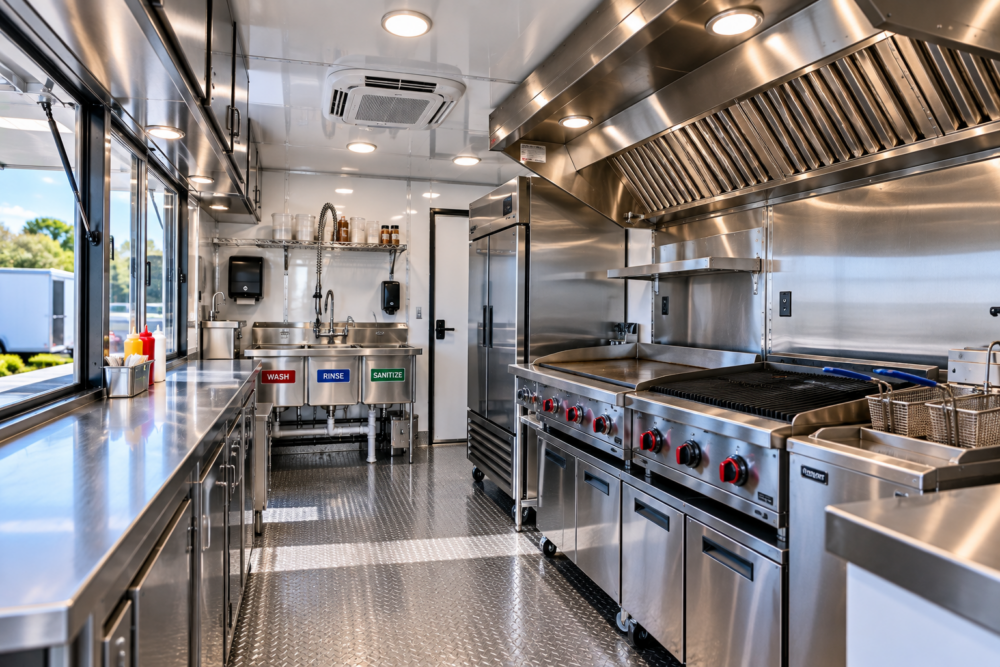
Planning to install fryers, grills, ranges or other cooking equipment?
This can substantially change the trailer.
Depending on your equipment and local requirements, you may need a commercial exhaust hood, ventilation system and fire-suppression equipment.
Fire code requirements may also involve a separate authority from the health department.
This is another reason Renown recommends determining your cooking equipment before the trailer layout is finalized.
Adding a fryer after a trailer has already been designed can involve much more than simply finding an empty space for it.
9. Refrigeration and Food Temperature Control
Food that requires temperature control for safety needs appropriate equipment and handling procedures.
Your food trailer may therefore require commercial refrigeration, freezers, hot-holding equipment or other temperature-control equipment based on your menu.
When designing the trailer, consider not only whether the refrigerator physically fits, but also:
- Electrical demand
- Ventilation
- Door clearance
- Counter space
- Food storage capacity
- Workflow
- Generator or shore-power capacity
Your appliances and electrical system need to work together.
10. Commercial Equipment May Need Specific Certifications
Before purchasing sinks, refrigerators, cooking appliances and other food-service equipment, ask your health department whether it requires equipment certified to particular sanitation standards.
The FDA Food Code recognizes equipment certified for conformance with appropriate American National Standards as complying with specified sanitation provisions. U.S. Food and Drug Administration
This is especially important when customers plan to purchase their own equipment after the trailer is built.
A bargain residential appliance isn’t necessarily suitable for a commercial mobile kitchen.
11. Your Food Trailer Layout Matters
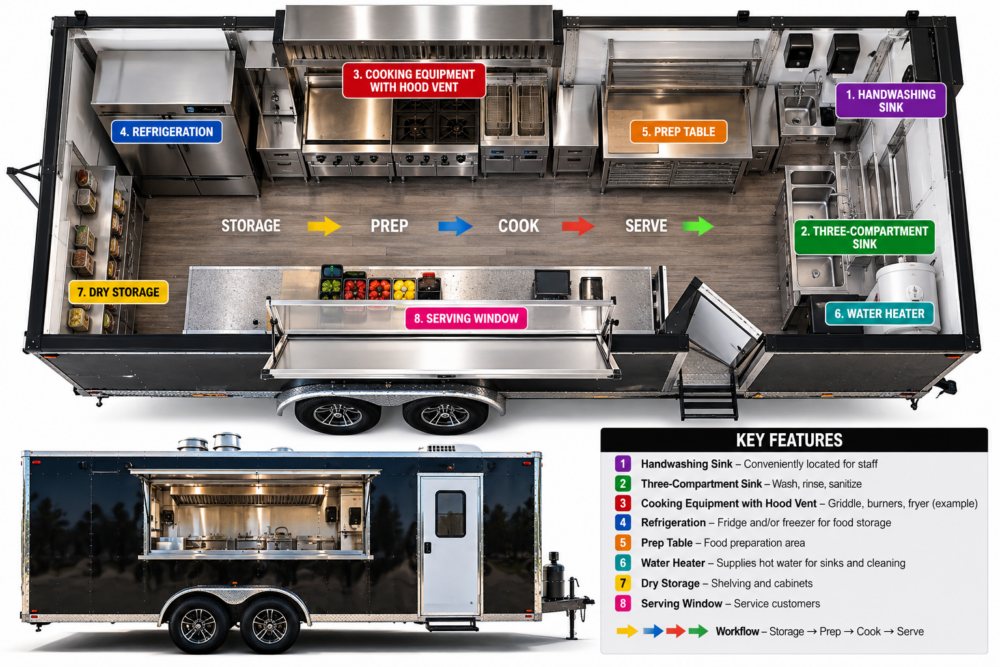
A good food trailer floor plan is about much more than fitting everything inside.
Think about the entire workflow:
Storage → Preparation → Cooking → Serving → Cleaning
Employees shouldn’t have to constantly cross paths or reach around equipment to complete basic tasks.
Consider where you’ll place:
- Handwashing sink
- Three-compartment sink
- Refrigerators and freezers
- Prep tables
- Cooking equipment
- Hood system
- Dry storage
- Water tanks
- Water heater
- Electrical panel
- Generator
- Propane
- Serving window
- Cabinets and shelving
A well-designed concession trailer can make a huge difference once you’re working through a busy lunch rush or event.
12. Do You Need a Commissary or Base of Operations?
Possibly.
Some jurisdictions require mobile food businesses to operate in conjunction with an approved commissary or base of operations.
This is another requirement that varies by location.
Georgia provides a good example. The Georgia Department of Public Health describes a Mobile Food Service Establishment as including both the base of operation (commissary) and the mobile food-service unit. Its guidance instructs operators to determine local ordinances first, establish a base of operation and obtain the appropriate health department permits. Georgia Department of Public Health
Georgia’s guidance also notes that the base may be used for activities such as dumping wastewater, refilling water tanks and restocking supplies. Georgia Department of Public Health
Other states and jurisdictions may handle commissary requirements differently.
13. You’ll Probably Need to Submit Plans Before Opening
Don’t wait until the food trailer is completed to introduce yourself to the health department.
Depending on your jurisdiction, you may need to submit plans before construction or before receiving a permit.
For example, Georgia’s mobile food-service guidance says applicants must submit information including their menu, a to-scale diagram or sketch of the base and mobile unit, and interior and exterior pictures, along with required applications and fees. Georgia Department of Public Health
Your jurisdiction may ask for additional information such as:
- Equipment specifications
- Plumbing diagrams
- Fresh and wastewater tank capacities
- Water heater specifications
- Finish materials
- Equipment certification information
- Hood and ventilation information
- Commissary information
- Proposed menu
Getting approval early can prevent an expensive redesign later.
14. Health Department Approval Isn’t the Only Approval You May Need
Passing the health inspection isn’t necessarily the final step.
Depending on where you’re operating, a mobile food business may also encounter requirements involving:
- Business licensing
- Fire inspection
- Propane systems
- Zoning
- Parking or vending locations
- Sales tax registration
- Building or electrical codes
- Commissary agreements
- Event permits
Georgia DPH specifically tells prospective mobile operators to check local city and county ordinances because those requirements are separate from health department regulations. Georgia Department of Public Health
What Should You Ask the Health Department Before Buying a Food Trailer?
Before you order a custom concession trailer, contact the authority that will issue your permit.
Have your proposed menu ready and ask them what they require for your specific operation.
Some of the most important questions include:
- What size handwashing sink do I need?
- Do I need a three-compartment sink?
- What size fresh water tank is required?
- What size wastewater tank is required?
- What are the hot-water requirements?
- Which equipment must be commercially certified?
- Do my walls, floors and ceilings meet your requirements?
- Will my cooking equipment require a hood and fire-suppression system?
- Do I need a commissary or base of operations?
- Do you require plan review before my trailer is built?
- What documents are required for the final inspection?
- Are there additional city or county requirements where I plan to sell food?
Build Your Food Trailer Around Your Business
The best food trailer isn’t simply the one with the most equipment.
It’s the trailer designed around your menu, your workflow, your local requirements and the way you intend to operate your business.
That’s why it pays to involve your health department early.
Once you know the requirements, Renown Cargo Trailers can help you design a custom food trailer or concession trailer around your business. From concession windows and cabinetry to sinks, plumbing, electrical systems, A/C, equipment layouts and custom configurations, your trailer can be designed around the way you plan to work.
Whether you’re starting a barbecue business, coffee trailer, bakery, dessert trailer, catering operation, mobile kitchen or another food-service concept, planning correctly from the beginning can save time, money and headaches when it’s time for inspection.
If you can dream it, we can build it.